
Voices from the holocaust
Music, Arts and Poetry from Theresiendtadt (Terezin) Ghetto/ Concentration Camp 1941-1945
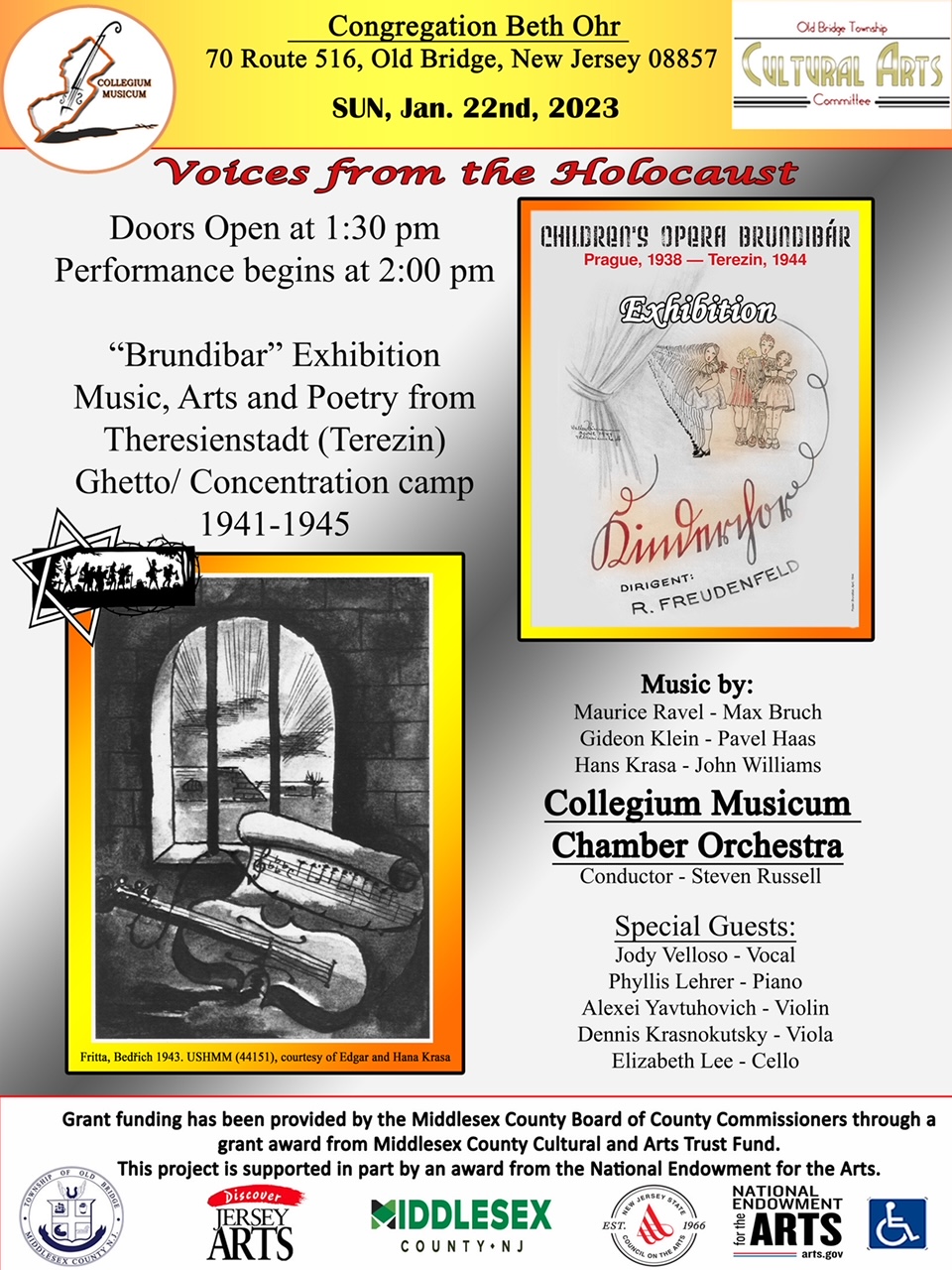
The Exhibition you are visiting today is dedicated to the Children’s Opera “Brundibar” which was on stage at the Terezin between 1942 and 1944.
The Exhibition created and provided for the project by Elena Makarova and EMI group, Haifa, Israel. Elena Makarova is an Israeli author, art-therapist, researcher and art-exhibition curator.
Elena started her research on the Jewish Ghetto/KZ Theresienstadt (Terezin) in 1988; since then she and her group have produced over 20 books and number of articles on Holocaust history, along with documentary films, Internet publications, etc. The EMI group have collected rich and comprehensive documentation on the cultural life in Terezin concentration camp. This collection and research provided foundation to over 30 major exhibitions around the World. The exhibition “Children’s Opera Brundibar” was originally created for 2005 lectures series for Holocaust studies, University of California, Berkeley. In Japan series of lectures and exhibitions was viewed by more than one million visitors.
Story of Terezin
Terezín (Theresienstadt, in German) is located 40 miles from Prague.
It was built as a walled garrison town and fortress in the 18th century by the Habsburg monarchy. During the Second World War, the Nazis evicted the civilian population and created the concentration camp they called the “Theresienstadt Ghetto.” Terezin was not a death camp (all six death camps were located in Poland) but, rather, a work camp and transit point for the nearly 150,000 Jews who passed through the camp between 1941 and 1945, 33,000 died in the camp and over 88,000 were transported to Auschwitz and other death camps. By war’s end, only about 19,000 were alive. Almost all were adults. Of the 15,000 children confined in the camp, less than one percent survived. Despite hunger, disease, and the constant threat of transports to the death camps, the arts flourished in Terezín.
Brundibár is an opera written for children. No more than forty minutes long, it was composed in 1938 by Hans Krása, with lyrics by Adolf Hoffmeister. In July 1943, the score of Brundibár was smuggled into camp, where it was re-orchestrated by Krása for the various instrumentalists who were available to play at that time. The premiere of the Terezín version took place on 23 September 1943 in the hall of the Magdeburg barracks. Realizing the propagandistic potential of this enormously popular artistic endeavor, the Nazis arranged a special new staging of Brundibár for the propaganda film (directed by Kurt Gerron), and the same production was performed for the inspection of Terezín by the International Red Cross in September 1944. This would be the last of the fifty-five performances in Terezín; two weeks later, transportation of artists to Auschwitz and other destinations East began, silencing the most popular theatrical production in Terezín.
RESERVE YOUR SEAT NOW
Limited seats available. You must reserve your seat by clicking the link below.
Please consider donating to help us support programs like this one and others like it in the future. You can make your donation as you reserve your seat. All donations are tax deductible as allowed by law.